Key Takeaways
- Calculate the total supported load, including the gearbox, attached components and adapters, before selecting rated capacity.
- Compare minimum saddle height with the available clearance beneath the vehicle. Check maximum height against the required installation position.
- Examine saddle contact points, adjustment range, base footprint and caster arrangement to assess stability.
- A hydraulic safety valve and mechanical locking system serve different functions. Neither replaces correct load positioning or independent vehicle support.
- Confirm model-specific dimensions, operating instructions and technical documents before placing a bulk order.
Introduction
A suitable transmission jack helps technicians lower, position and reinstall gearboxes during vehicle maintenance. However, rated capacity alone does not determine whether a model is suitable. Buyers also need to check lifting height, saddle stability, mobility and safety features. These factors affect whether the equipment can reach the required working position and support the component securely during handling.
How Do You Choose the Right Capacity and Lift Range?
Capacity and lifting height should be checked together. A jack may have enough lifting force but still fail to fit beneath a vehicle or reach the required installation position.
Calculate the Required Load Capacity
Start with the weight of the transmission. Then include any attached parts that will remain on the jack during removal or installation. Adapters and support fixtures should also be included if their weight is carried by the lifting platform.
For example, consider a gearbox weighing 280 kg, an attached component weighing 45 kg and adapters weighing 15 kg. The total supported load is 340 kg. A jack rated at exactly 340 kg would leave no capacity margin. Buyers should select a higher-rated model and follow the manufacturer’s load limits.
A transmission jack heavy duty model may be suitable for heavier assemblies, but the product name alone does not confirm its actual capacity. Check the rated load on the specification sheet and the equipment marking. OSHA 29 CFR 1910.244 requires a jack to have a rating sufficient for the load and requires its rated load to be permanently marked.
Compare Minimum and Maximum Lifting Heights
The minimum saddle height determines whether the jack can fit beneath the gearbox before lifting. The maximum height determines whether it can raise the component to the required working position.
For example, if the available clearance beneath a vehicle is 180 mm, a jack with a 200 mm minimum height will not fit into that space. Similarly, if the gearbox must be raised to 1,080 mm but the jack reaches only 1,000 mm, the lifting range is insufficient.
Ask suppliers to confirm how they measure minimum and maximum heights. Some specifications refer to the saddle surface, while others may use a different reference point. Compare measurements on the same basis.
Choose Between Telescopic and Low-Profile Designs
A low-profile design is useful when clearance beneath the vehicle is limited. Its main selection point is the minimum height: the saddle must be low enough to enter the available space.
A telescopic design can provide an extended lifting range through its lifting structure, depending on the model. Buyers should check the minimum height, maximum height and usable lifting stroke rather than assuming that a telescopic model will automatically fit every vehicle.
The lifting stroke is the difference between the maximum and minimum heights. For example, a jack with a 200 mm minimum height and a 1,000 mm maximum height has an 800 mm stroke. This figure describes the available vertical travel, but it does not show whether the jack can fit beneath a low vehicle.
| Selection Point | Low-Profile Design | Telescopic Design |
| Main consideration | Minimum height and under-vehicle clearance | Minimum height, maximum height and lifting stroke |
| Clearance requirement | Useful where space beneath the vehicle is limited | Depends on the model’s minimum height |
| Height adjustment | Depends on the lifting mechanism | Uses a telescopic lifting structure |
| Buyer check | Confirm the lowest saddle position | Confirm both end heights and the usable stroke |
Neither design is suitable for every workshop. Select the structure by comparing its actual dimensions with vehicle clearance and the required gearbox installation height.
Which Saddle, Base and Safety Features Should Buyers Compare?
The support structure affects how securely a gearbox sits on the jack. Buyers should examine contact points, load position and movement rather than relying only on rated capacity.
Check Saddle Contact and Adjustment
The saddle should support suitable load-bearing areas of the gearbox housing. Avoid placing support points against thin covers, fragile fittings or components that are not designed to carry the load.
Check three details before selecting a model:
- Contact position: Confirm that the saddle can reach suitable support points on the gearbox. The contact area should prevent the component from slipping or shifting during handling.
- Center of gravity: The gearbox’s center of gravity should remain within the support area. This is particularly important as the gearbox separates from the engine or other connected parts during removal.
- Adjustment range: Confirm whether the saddle can tilt or change angle to match the gearbox mounting position. Ask for the adjustment direction and range if these details are not shown in the specification sheet.
A saddle that can be adjusted in the required direction makes alignment easier. However, adjustment alone does not guarantee stability. The load must remain properly balanced throughout the lifting process.
Examine the Base and Casters
A stable base helps reduce unwanted movement while the gearbox is being raised or lowered. Compare the base footprint, wheel arrangement and distance between the casters. A wider footprint may improve stability, but it must also fit within the available workshop space.
Swivel casters can help technicians move the jack around a vehicle and align it with the gearbox. For narrow service bays, check the base dimensions and turning clearance before ordering. Also confirm whether the wheels have brakes or locking functions. Do not assume that all swivel casters include a locking mechanism.
The floor condition matters as well. The jack should be used on a firm, level surface. A mobile base cannot compensate for an uneven or unsuitable floor.
Understand Hydraulic and Mechanical Safety Features
A hydraulic safety valve can help protect the lifting circuit from excessive pressure. A mechanical locking system may provide an additional way to secure the lifting structure. These functions are different, so buyers should confirm what each feature does and how it is operated.
A safety valve does not replace correct load positioning, regular inspection or suitable support equipment. The UK Health and Safety Executive advises that vehicles must not be supported by jacks alone when work is carried out underneath them.
Which Documents and Supplier Details Should Buyers Verify?
A product description is not enough for technical purchasing. Buyers need model-specific information that allows them to compare performance, dimensions and safety requirements.
Check Applicable Standards and Technical Documents
ASME PASE-2024 covers safety and performance requirements for portable automotive service equipment. Its scope includes several types of automotive jacks and component-handling equipment. However, buyers should not assume that every product complies with the standard simply because it belongs to this category. Ask the supplier for relevant conformity documents and test information. The standard’s scope is available through the ANSI Webstore.
For hydraulic transmission jacks, request a specification sheet and operating manual. Check the rated capacity, minimum and maximum lifting heights, saddle design, base dimensions, caster details and safety features. These documents should identify the exact model being quoted.
Compare the Quoted Model with the Intended Application
A supplier quotation should match the model shown in the technical documents. Check whether the quoted capacity, accessories and configuration are the same as those discussed during technical communication.
For fleet workshops or distributors, also confirm packaging details, spare-part availability and the documents supplied with each unit. These details help buyers assess whether the equipment can be stored, distributed and maintained as planned.
Before comparing quotations, use a consistent selection sequence:
- Calculate the total weight that the jack must support.
- Check whether the minimum height fits beneath the vehicle.
- Confirm that the maximum height reaches the required installation position.
- Examine saddle contact, adjustment range and base dimensions.
- Verify the safety features, operating manual and model-specific documents.
This sequence helps buyers compare equipment based on working requirements rather than price or rated capacity alone.
Why Choose OTOY Telescopic Hydraulic Transmission Jacks?
OTOY lists telescopic hydraulic transmission jack options for gearbox handling. The available product information identifies two capacity configurations and several practical design features. Buyers should confirm the exact specifications for the selected model before ordering.
| Item | Available Product Information |
| Capacity options | 0.5/0.6 ton and 1 ton options; confirm the exact model configuration |
| Lifting structure | Telescopic design |
| Height adjustment | Adjustable lifting height; exact minimum and maximum heights should be confirmed |
| Mobility | 360-degree swivel wheels |
| Safety features | Built-in safety valve and locking system |
| Intended use | Gearbox and transmission removal, installation and support |
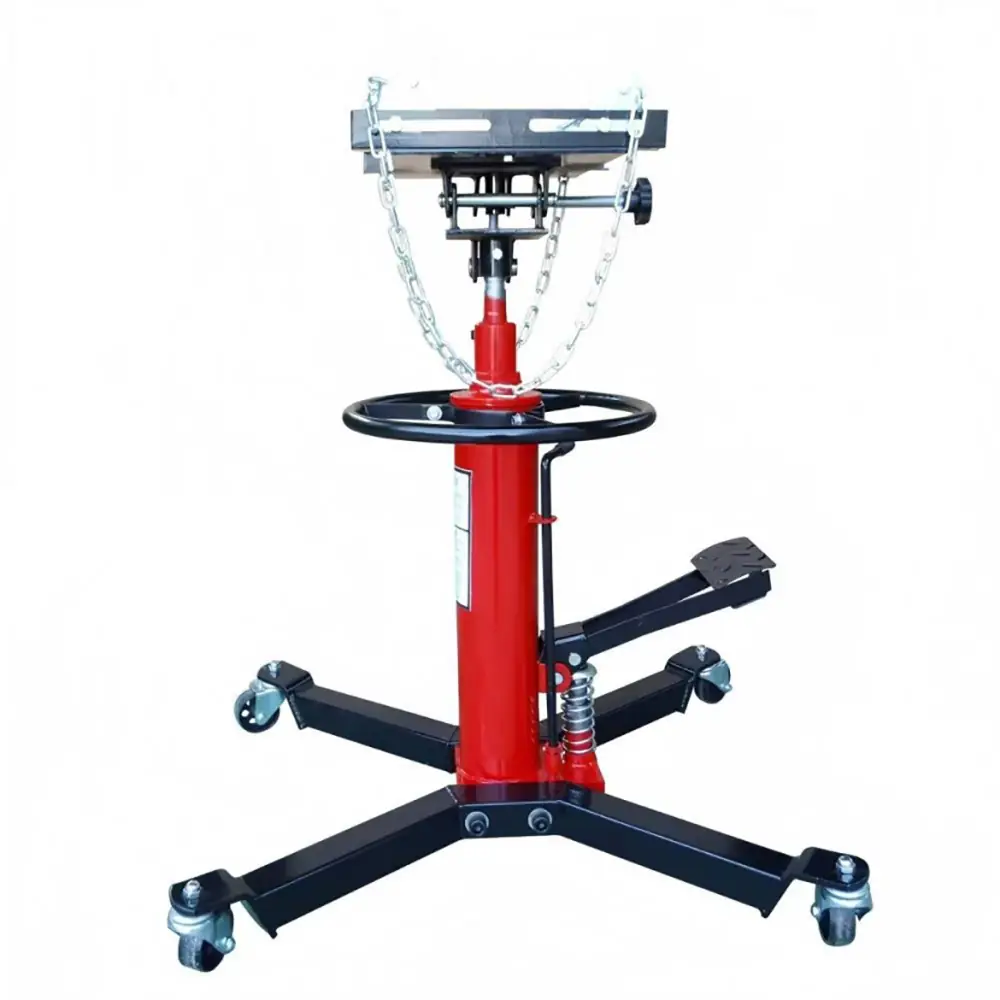
Telescopic Structure for Flexible Lifting Positions
The telescopic structure allows the lifting height to be adjusted for different working positions. This is useful when technicians need to lower a gearbox from its mounting position and then raise it again during installation.
The usable lifting range determines how much vertical adjustment is available during these operations. Buyers should confirm the minimum height, maximum height and lifting stroke for the selected model. These measurements show whether the jack can fit the vehicle and reach the required installation position.
Capacity Options for Different Gearbox Loads
The listed capacity options include 0.5/0.6 ton and 1 ton configurations. This gives buyers options for different gearbox weights and workshop requirements.
The selected capacity should be based on the total supported load, not only the gearbox’s dry weight. For example, attached components and adapters may increase the load carried by the jack. Confirm the rated capacity of the exact model before using it for a particular gearbox assembly.
360-Degree Swivel Wheels for Workshop Positioning
The product is equipped with 360-degree swivel wheels. This design can help technicians move the jack around a vehicle and adjust its position during gearbox handling.
During installation, small positioning adjustments may be needed to align the gearbox with its mounting points. Swivel wheels can make it easier to reposition the equipment within the workshop. Buyers should still check the base dimensions and turning clearance, especially in narrow service bays.
Built-In Safety Valve and Locking System
The listed model includes a built-in safety valve and locking system. These features provide additional protection during lifting and positioning.
Buyers should ask how the locking system engages and whether it is intended to secure the lifting structure at a particular stage of operation. The operating manual should explain the correct procedure. Operators must also follow the rated capacity and inspection requirements.
Applications in Gearbox Removal and Installation
A telescopic hydraulic model can support a gearbox during removal, lower it from the vehicle and position it for installation. It can also help technicians make controlled height adjustments while aligning the component with its mounting points.
For workshops that service different vehicle types, the main checks are capacity, lifting range and saddle compatibility. Confirm these details against the gearbox models handled most frequently in the workshop.
Frequently Asked Questions About Transmission Jacks
How Much Capacity Margin Should a Transmission Jack Have?
The required margin depends on the load, equipment design and manufacturer’s instructions. Buyers should first calculate the total weight carried by the jack, including attached components and adapters. They should then select a model with a rated capacity above that total and follow the manufacturer’s specified limits. Do not treat the rated capacity as a target load to exceed.
Does This Model Have an Adjustable Lifting Height?
Yes. The product information identifies a telescopic lifting structure with adjustable height. However, exact minimum and maximum heights are not specified in the available information. Ask the supplier for the measurements of the selected model.
How Should a Gearbox Be Secured on a Transmission Jack?
The gearbox should rest on suitable support points, with its center of gravity kept within the saddle’s support area. Use the securing accessories specified by the equipment manufacturer. Before lifting or lowering, check that the gearbox cannot shift or slide. Never rely on an improvised support arrangement.
What Is the Difference Between a Transmission Jack and an Engine Crane?
A transmission jack supports and positions a gearbox or transmission during removal and installation. An engine crane is generally used to lift and move an engine. The search phrase hydraulic jack engine crane may combine these equipment terms, but the two products are not interchangeable. Buyers should select equipment according to the component being lifted and the required lifting method.
Can a Transmission Jack Be Used for Truck Gearboxes?
It depends on the gearbox weight, dimensions and required lifting height. A truck transmission jack must have sufficient rated capacity and a saddle that can support the gearbox securely. Buyers should also check whether the base can move within the available space beneath the truck.
Conclusion
A suitable transmission jack should match the gearbox load, vehicle clearance and required installation height. Saddle contact and base stability matter just as much as lifting capacity. In a busy workshop, caster mobility can also make it easier to position equipment around a vehicle and complete repeated maintenance tasks.
If you are looking for a hydraulic transmission jack supplier, contact OTOY for available capacity options, telescopic design details, technical specifications and a quotation based on your required load, lifting range, workshop application and order quantity.