Key Takeaways
- Start with the heaviest vehicle you need to service and make sure the jack’s rated capacity covers the lifting task.
- Compare the minimum lift height with the vehicle’s lifting-point clearance, then check whether the maximum height provides enough working space.
- For an electric model, check the operating voltage, rated power, maximum current, connection method, and cable length.
- Roadside service benefits from portability and integrated functions, while workshop and fleet use place more emphasis on repeated operation, stability, and maintenance.
- Check the rated capacity and relevant automotive service safety requirements before selecting the equipment.
Introduction
Choosing a hydraulic car floor jack is not only about lifting capacity. The jack must fit under the vehicle, reach the lifting point, provide enough working height, and match the available power source when electric lifting is used. The jack should match the vehicle, lifting point, power source, and service conditions.
What Should You Check Before Choosing a Hydraulic Car Floor Jack?
Vehicle weight and underbody clearance vary between applications, so the jack needs to match both the load and the space available under the vehicle. Hydraulic performance also affects how smoothly the equipment can be operated and maintained.
How Much Lifting Capacity Do You Need?
Rated capacity determines the load a jack is designed to lift and support. Start with the heaviest vehicle the equipment will service, but do not compare capacity with vehicle gross weight alone. Because the jack works at a specific lifting point, the actual lifting task also matters.
When choosing a 3 ton floor jack, make sure the target vehicle and lifting task fall within the 3-ton rated capacity. If heavier vehicles will also be serviced, a higher capacity configuration may be required.
OSHA requires jacks to have sufficient rated capacity for the load being lifted or supported, making this a basic safety and selection requirement.
How Should You Compare Minimum and Maximum Lift Height?
Lift height determines whether the jack can reach the vehicle and whether there is enough space to carry out the repair. A jack with sufficient capacity is still unsuitable if it cannot fit under the vehicle or cannot raise it high enough for the intended task.
Minimum lift height is especially important for vehicles with low ground clearance. If the starting height is too high, the jack may not reach the lifting point.
Maximum lift height matters when the repair requires more space below the vehicle. When comparing a car floor jack, check the clearance needed at the vehicle’s lifting point first, then confirm that the maximum height provides enough working space.
What Hydraulic Performance Should You Check?
Hydraulic performance affects how smoothly the vehicle is raised, held, and lowered. Poor control can make positioning more difficult during service, while hydraulic leakage can increase maintenance needs over time.
For regular workshop use, buyers should check lifting stability, lowering control, leakage risk, ease of operation, and maintenance requirements. If the jack will be used repeatedly, stable operation and simple maintenance are more important than adding functions that may not be used.
What Electrical Specifications Matter for an Electric Floor Jack?
Electric lifting adds another selection point because the jack must work with the vehicle’s available power source. A suitable mechanical configuration is not enough if the electrical requirements do not match.
Check Voltage, Rated Power and Maximum Current
Operating voltage, rated power, maximum current, and connection method determine whether the jack can work with the intended vehicle and power source.
A 12V model still needs a suitable connection and sufficient electrical supply. Buyers should check voltage, rated power, maximum current, and connection method together rather than looking only at the voltage.
For an electric floor jack, the electrical requirements should match the vehicle’s power source and the way the equipment will be connected during service.
Why Does Power Cable Length Matter?
Cable length affects where the jack can be positioned in relation to the vehicle’s power connection. A cable that is too short may restrict placement and make roadside operation less convenient.
The cable should be long enough to reach the working position while keeping the connection practical. This is particularly useful for roadside service, where the vehicle and working position may vary from one job to another.
When Is Integrated Tire Inflation Useful?
A tire problem can occur during the same service task as a tire change, so an integrated inflator can reduce the need to carry another piece of equipment.
If the jack will be used for roadside tire service, check inflation pressure, airflow, and hose length together. A higher pressure rating alone does not show how practical the inflator will be during actual use. Airflow affects inflation speed, while hose length affects how easily the inflator can be positioned around the vehicle.
Which Features Matter for Roadside and Workshop Use?
The right configuration depends on how the jack will be used. Roadside service usually benefits from a compact kit with several functions, while workshop and fleet operations place more emphasis on repeated lifting, stability, and maintenance.
What Matters for Roadside Service?
Roadside work often takes place with limited equipment and changing working conditions. A compact kit with integrated service functions can reduce the number of separate tools that need to be carried.
An integrated setup is useful when the operator needs to lift the vehicle, remove a wheel, inflate a tire, or work in low-light conditions. Combining these functions can make a mobile service kit easier to transport and prepare.
What Matters for Workshop and Fleet Service?
Workshop and fleet operations can involve repeated lifting throughout the working day. In this environment, capacity, lift range, stability, mobility, maintenance, and durability become more important than emergency-oriented accessories.
A roadside-focused configuration may include useful extra functions, but workshop buyers should first make sure the basic lifting performance matches the vehicles being serviced. The equipment should also be practical to move and maintain during repeated use.
| Application | Main Priority |
| Roadside service | Compact kit and multiple functions |
| Workshop service | Lift range and repeated operation |
| Fleet service | Capacity and durability |
What Should Be Included in the Kit?
The package contents affect how much additional equipment needs to be purchased and transported. Buyers should check whether the kit includes the accessories needed for the intended service work.
Depending on the configuration, the kit may include a power cable, air hose, inflation equipment, lighting, electric impact wrench, storage case, or other accessories. The final configuration should be confirmed against the quotation and packing list.
Safety Requirements Go Beyond Rated Capacity
Rated capacity is an important part of safe jack selection, but it is not the only consideration. For automotive service equipment, buyers should also consider requirements related to design, operation, maintenance, performance, and inspection.
Which Automotive Jack Standard Should Buyers Check?
ASME PASE-2024 is specifically intended for portable automotive service equipment. It covers areas including design, construction, marking, operation, maintenance, performance, and inspection.
For buyers, this provides a relevant reference when evaluating portable equipment for automotive service. Lifting capacity is only one part of the evaluation. Design, operation, maintenance, performance, and inspection requirements should also be considered, especially for roadside and mobile service.
12V Electric Hydraulic Car Jack for Roadside Service
The ZSY01-X is designed for roadside vehicle service where lifting, tire inflation, lighting, and tire-changing support may be needed in one compact kit. It is available in 3-ton and 5-ton configurations and is designed around a 12V vehicle power source.
| Specification | ZSY01-X |
| Capacity | 3 ton / 5 ton |
| Operating Voltage | DC12V |
| Rated Power | 180W |
| Maximum Vehicle Weight | Up to 5T |
| Lift Range | 135–360mm / 155–450mm / 155–530mm |
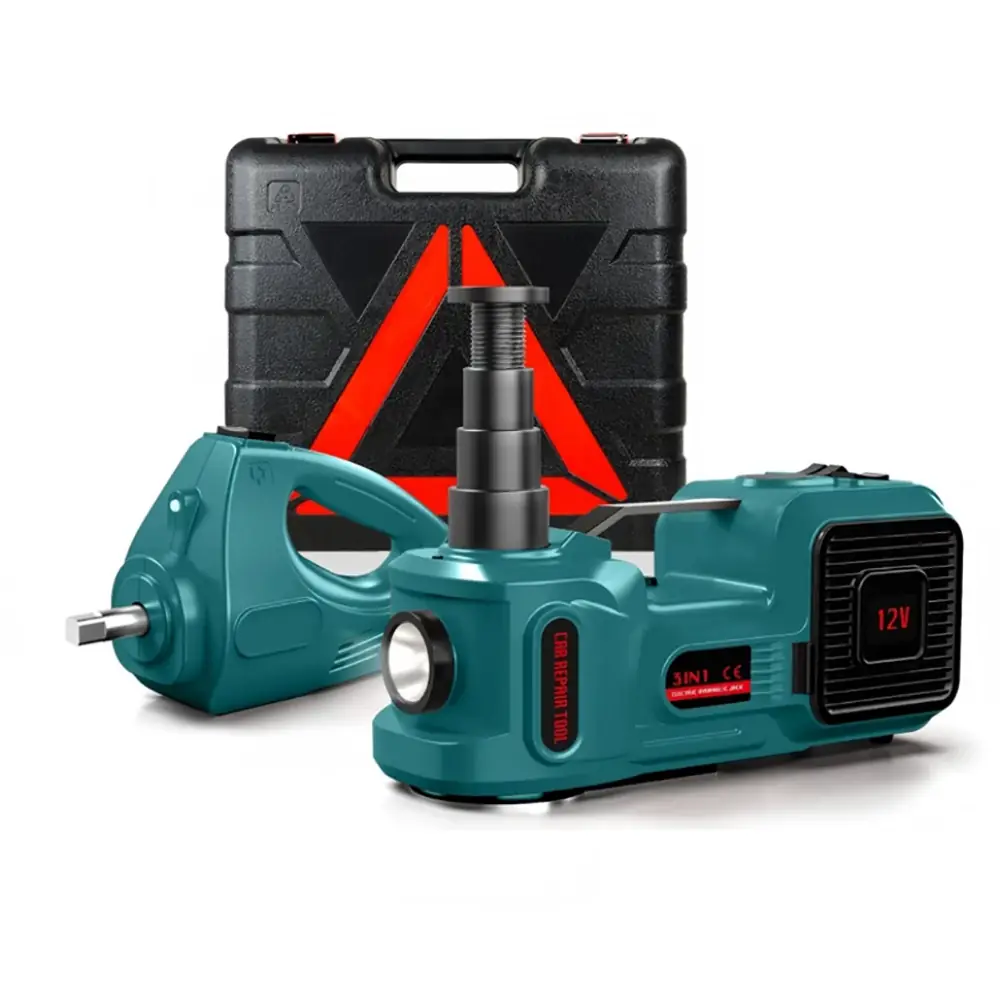
Electric Hydraulic Lifting
Manual jacks require repeated pumping during lifting, which can add physical effort during roadside service. Electric hydraulic lifting reduces this manual operation and makes the lifting process more convenient.
The ZSY01-X uses DC12V power and offers 3-ton and 5-ton capacity options. Its available lift configurations also provide different height ranges for different vehicle applications.
Integrated Tire Inflation and Work Light
Roadside tire service may require more than lifting the vehicle. After a tire change or repair, the tire may also need inflation, while poor lighting can make roadside work more difficult.
The ZSY01-X includes an inflation function with pressure up to 150psi, airflow of 35L/min, and a 0.65m air hose. An LED work light is also included for service in low-light conditions.
Complete Emergency Service Kit
Carrying separate lifting, inflation, lighting, and tire-changing equipment can make roadside service kits larger and harder to organize. An integrated kit reduces the number of separate tools required for common roadside tasks.
The ZSY01-X includes an electric impact wrench, 3.5m power cable, hard storage case, and reflective triangle in addition to its lifting and inflation functions. This combination supports mobile tire-changing work while making the equipment easier to transport and store.
Frequently Asked Questions
Is the ZSY01-X available as a 3 ton hydraulic floor jack?
Yes. The ZSY01-X is available in 3-ton and 5-ton capacity configurations. The maximum vehicle weight is up to 5T, so the appropriate configuration should be selected based on the target vehicle and lifting task.
What lift ranges are available for the ZSY01-X?
The available lift configurations are 135–360mm, 155–450mm, and 155–530mm. Buyers should compare these ranges with the vehicle’s underbody height and the working space required for the service task.
Can the ZSY01-X inflate tires?
Yes. The ZSY01-X includes a tire inflation function with a maximum pressure of 150psi, airflow of 35L/min, and a 0.65m air hose.
Why is minimum lift height important for a hydraulic car floor jack?
Minimum lift height determines whether the jack can fit under the vehicle and reach the lifting point. If the minimum height is too high, the jack may not be suitable for a low-clearance vehicle even if its rated capacity is sufficient.
Why is a 12V power connection important for an electric car jack?
A 12V connection allows the jack to use a vehicle’s available electrical power, but voltage alone does not determine compatibility. Buyers should also check rated power, maximum current, and the connection method to make sure the equipment matches the intended vehicle and application.
Conclusion
For roadside service, a floor jack should do more than lift a vehicle. A compact design with integrated inflation, lighting, and tire-changing tools can reduce the equipment needed for mobile service.
The ZSY01-X is designed for service teams that need lifting equipment that can also support common tire-service tasks. With 3-ton and 5-ton capacity options and three available lift configurations, buyers can choose a setup that matches the vehicles and working heights they need to handle. The 12V electric design also makes it suitable for mobile service where access to a vehicle power source is available.
For buyers, this type of configuration can simplify equipment planning by combining several roadside service functions in one portable kit. It can be considered for emergency roadside assistance, mobile tire service, and other vehicle service tasks where equipment needs to be transported between locations.
If you are looking for a reliable hydraulic car floor jack supplier, feel free to contact OTOY for product options, specifications, and quotations based on your vehicle types, lifting requirements, and purchasing needs.