Key Takeaways
- A semi electric pallet stacker uses battery power to lift loads while the operator manually moves and steers the machine.
- It is suitable for warehouses and production areas where powered lifting is useful, but fully powered travel is not essential.
- Important specifications include rated capacity, lifting height, load center, battery type, fork dimensions, mast configuration, and overall dimensions.
- A higher rated capacity does not automatically make a stacker suitable for every application. Load center and lifting height also affect the usable capacity.
- The right configuration depends on pallet type, aisle conditions, stacking height, operating frequency, and available floor space.
What Is a Semi Electric Pallet Stacker?
A semi electric pallet stacker is a material handling machine that combines manual travel with electrically powered lifting. The operator usually pushes or pulls the stacker into position and steers it manually. The battery-powered hydraulic system raises and lowers the forks.
This type of stacker sits between a manual pallet stacker and a fully electric stacker forklift.
A manual stacker relies on mechanical or hydraulic force generated by the operator. A fully electric stacker uses an electric drive system for both lifting and travel. A semi electric stacker keeps travel manual while adding powered lifting, which reduces the physical effort required for repeated lifting operations.
A typical machine includes a mast, forks, hydraulic lifting components, battery, control handle, load wheels, and steering wheels. Depending on the model, buyers can choose different mast heights, fork configurations, battery capacities, and load-handling options.
For warehouses that handle pallets at moderate stacking heights, this design can offer a practical balance between lifting assistance, equipment cost, and operating simplicity.
How Does a Semi Electric Pallet Stacker Work?
The lifting function is powered by an electric motor and battery. When the operator activates the lifting control, the motor drives a hydraulic pump. Hydraulic fluid then moves into the lifting cylinder, raising the forks through the mast.To lower the forks, the operator releases the hydraulic pressure through a valve or lowering control on the handle.
The operator moves the stacker manually by pushing or pulling it into position. The steering handle controls direction, while the brake keeps the machine stationary during loading, unloading, and stacking.
The basic operating sequence is:
- Position the forks underneath the pallet.
- Make sure the pallet is properly supported by the forks.
- Use the electric lifting control to raise the load.
- Move the stacker manually to the required position.
- Position the load at the desired storage level.
- Lower the forks and release the pallet.
- Move the forks clear of the pallet before repositioning the stacker.
The exact controls and hydraulic arrangement vary by model. Operators should follow the manufacturer’s instructions and applicable workplace safety requirements.
Semi Electric Stacker vs. Manual Pallet Stacker
The main difference is how the forks are raised.
A manual pallet stacker requires the operator to generate lifting force through a hydraulic pump, lever, or another mechanical mechanism. A semi electric pallet stacker uses battery-powered lifting, which reduces the physical effort required during repeated lifting operations.
| Feature | Manual Pallet Stacker | Semi Electric Pallet Stacker |
| Fork lifting | Manual/mechanical | Electric-hydraulic |
| Travel | Manual | Manual |
| Operator effort | Higher | Lower during lifting |
| Battery | Usually not required | Required |
| Lifting speed | Operator-dependent | More consistent |
| Typical use | Light-duty handling | Repeated lifting and stacking |
| Equipment complexity | Lower | Moderate |
| Operating cost | Generally low | Depends on battery and charging |
For occasional pallet handling, a manual stacker may be sufficient. When operators lift pallets repeatedly throughout a shift, powered lifting can reduce physical effort and provide more consistent operation.
Semi Electric Pallet Stacker vs. Electric Stacker Forklift
A semi electric pallet stacker is also different from a fully electric stacker forklift.
A fully electric stacker generally has powered travel as well as electric lifting. The operator controls both functions through the tiller or driving controls.
A semi electric model keeps travel manual.
This distinction becomes important when assessing the working environment. If the stacker covers short distances with frequent stops, powered travel may not be necessary. However, if loads must be moved across a large warehouse or handled continuously throughout a shift, a fully electric stacker may offer better productivity.
The right choice therefore depends on the lifting requirements and the amount of travel involved.
Key Specifications to Compare
When selecting a semi electric pallet stacker, several specifications need to be considered together.
Rated Capacity
Rated capacity refers to the maximum load a stacker is designed to lift under the manufacturer’s specified conditions.
Common configurations include 1,000 kg, 1,500 kg, and 2,000 kg models, although available capacities vary by manufacturer.
Capacity should always be considered alongside load center and lifting height. A 2,000 kg rating does not mean that a 2,000 kg load can be lifted to every available mast height.
The manufacturer’s load chart shows how the rated capacity applies under different operating conditions.
Lifting Height
Lifting height determines how high the forks can raise a pallet.
A shorter mast may be sufficient for low-level stacking. Higher warehouse racks, however, require greater lifting height and may also involve additional capacity considerations.
When specifying lifting height, measure the actual storage position. There should also be enough clearance to place and remove the load safely.
Load Center
Load center is an important specification because it directly affects lifting performance.
It refers to the horizontal distance from the vertical face of the forks to the load’s center of gravity under the manufacturer’s rated conditions.
If the load extends farther forward than the rated load center, the effective lifting capacity may decrease. This matters when handling long, deep, or unevenly distributed loads.
Fork Dimensions
Fork length and width need to match the pallets being handled.
Forks that are too short may not provide enough support. If the fork dimensions do not match the pallet openings, positioning the stacker can also become more difficult.
Before purchasing, confirm the pallet dimensions, entry direction, and fork pocket dimensions used at the facility.
Mast Configuration
Mast configuration affects both lifting height and the stacker’s overall dimensions.
A taller mast provides access to higher storage positions. At the same time, the lowered mast height determines whether the machine can pass through doors, entrances, or other areas with limited clearance.
For facilities with height restrictions, check both the raised and lowered dimensions before selecting a model.
Battery Type and Capacity
Battery specifications affect how long the stacker can operate between charging cycles.
Lead-acid batteries are widely used in material handling equipment because they are a well-established technology and are relatively straightforward to maintain. Other battery options may also be available, depending on the manufacturer and model.
When comparing machines, look at battery voltage, capacity, charging requirements, and expected operating time. Battery type alone does not provide enough information to judge operating suitability.
Overall Dimensions
The stacker’s overall length and width affect whether it can move efficiently through the available workspace.
A machine with sufficient lifting capacity can still be difficult to use if it cannot maneuver around racks, production equipment, doors, or loading areas.
Before purchasing, measure the narrowest aisles and operating areas where the stacker will be used.
How to Choose the Right Semi Electric Stacker
Start with the actual load and warehouse conditions.
Determine the Required Capacity
Identify the heaviest pallet that needs to be handled. Also consider whether the load is evenly distributed.
If the normal working load is close to the machine’s rated limit, a higher-capacity model may be more appropriate for regular operation.
Check the Required Lifting Height
Measure the height of the highest pallet storage position.
Allow for pallet height and the clearance needed to place or remove the load. The selected lifting height should match the actual rack or stacking arrangement.
Confirm the Load Center
Determine how far the load’s center of gravity sits from the fork face.
This is particularly important for loads that are deep, long, or unevenly distributed.
Match the Forks to the Pallets
Check the pallet length, width, fork entry openings, and the direction from which the pallet will normally be approached.
Standard pallets may allow greater flexibility. Specialized pallets can require specific fork dimensions or configurations.
Evaluate Aisle and Door Dimensions
Measure aisle width, doorway clearance, turning areas, and height restrictions.
The lowered mast height is especially important when the stacker must pass through doors or under other low-clearance structures.
Consider Operating Frequency
A semi electric stacker is generally well suited to applications where powered lifting is needed but the machine does not have to travel long distances under its own power.
For frequent material movement across a large facility, powered travel may provide enough productivity benefits to justify a fully electric stacker.
Which Configuration Is Best for Your Application?
Different warehouse conditions call for different specifications.
| Application | Capacity Consideration | Lifting Requirement | Important Configuration |
| Small warehouse | 1,000–1,500 kg | Low to medium | Compact dimensions |
| General pallet stacking | 1,500–2,000 kg | Medium | Standard forks and mast |
| Higher storage positions | Based on load chart | High | Suitable mast configuration |
| Heavy pallet handling | 2,000 kg or above | Medium/high | Higher capacity and suitable load center |
| Restricted doorways | Based on load | Varies | Low lowered mast height |
| Frequent lifting | Based on workload | Varies | Adequate battery capacity |
| Long-distance internal transport | Based on workload | Varies | Consider powered travel |
These ranges are general selection references. The final specification should be based on the manufacturer’s rated capacity, load chart, dimensions, and the actual working conditions.
OTOY 2 Ton Semi Electric Straddle Pallet Stacker
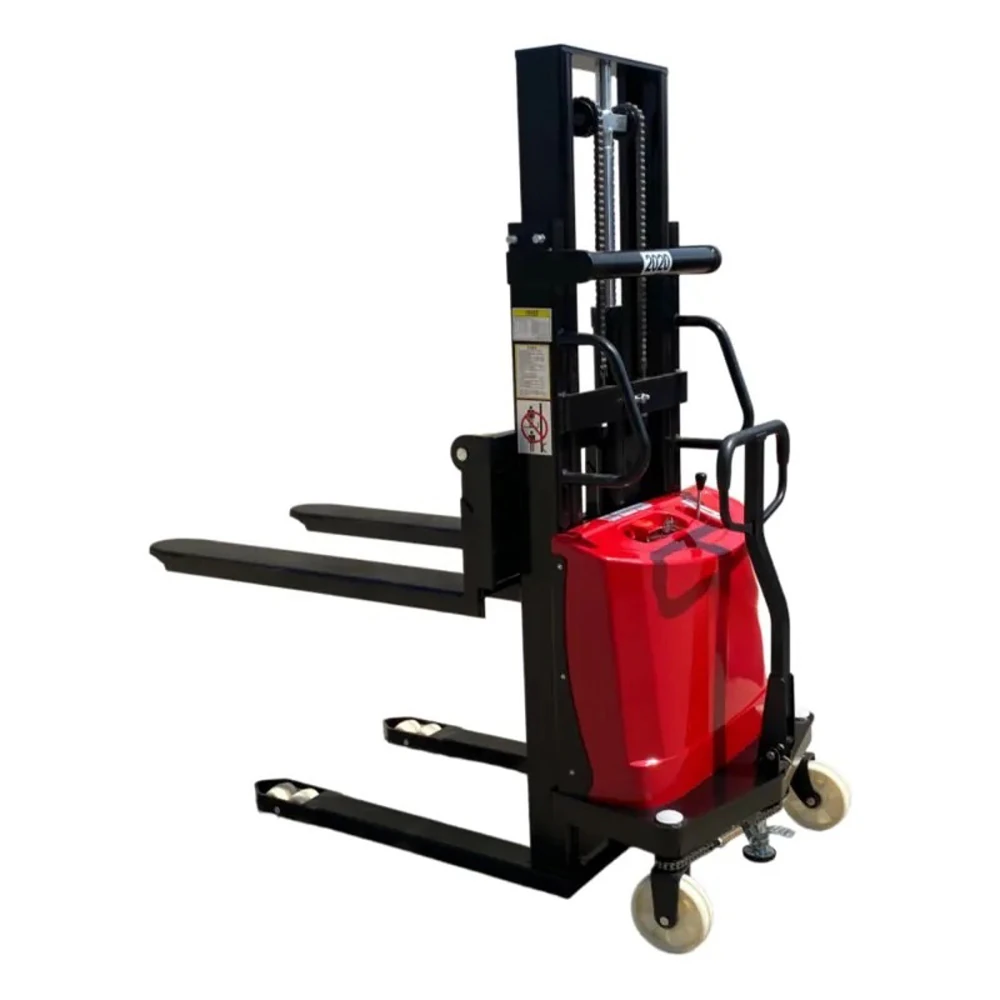
For applications that require higher lifting capacity while retaining manually controlled travel, OTOY’s 2-ton semi electric straddle pallet stacker offers a practical configuration. The machine has a 2,000 kg rated capacity and a 1.6 m lifting height, making it suitable for heavier palletized loads and low- to medium-level stacking. Its electric lifting function is powered by a 1.6 kW motor, reducing the physical effort required when lifting pallets repeatedly during daily operations.
The fork configuration also gives buyers some flexibility when matching the stacker to different pallet sizes. It uses 1,100 mm-long forks, with an adjustable fork width of up to 720 mm. Combined with the straddle-leg design, this arrangement provides clearance around the pallet and can accommodate a range of pallet handling requirements. Buyers should still confirm pallet dimensions and fork entry measurements before ordering.
For warehouse layout, the machine has an overall width of 850 mm and a listed 1,350 mm turning radius. These dimensions can be useful when the stacker needs to work in relatively confined areas, although the actual space required will depend on pallet size and operating conditions. The machine uses a 73 Ah/12 V lead-acid battery for its powered lifting function.
Taken together, the configuration fits the selection criteria discussed above: a 2-ton capacity for heavier loads, 1.6 m lifting height for lower storage positions, adjustable forks for pallet flexibility, and manual travel for short-distance handling. It is therefore a suitable option for warehouses, workshops, and production areas that need powered lifting without the added complexity of powered travel.
Frequently Asked Questions
Can a semi electric pallet stacker move by itself?
Most semi electric pallet stackers use electric power for lifting while the operator pushes or pulls the machine manually. Models with powered travel are generally classified as fully electric or powered stackers.
What is the typical capacity of a semi electric stacker?
Capacity varies by model. Common industrial configurations range from approximately 1,000 kg to 2,000 kg, although some manufacturers offer higher-capacity models. The rated capacity must be considered together with load center and lifting height.
How high can a semi electric pallet stacker lift?
Lifting height depends on the mast configuration. Models are available for low-level stacking as well as higher storage applications. Buyers should select the lifting height according to the actual rack or stacking position.
Is a semi electric stacker suitable for heavy loads?
It can be, provided the load remains within the manufacturer’s rated capacity and operating conditions. A 2-ton model, for example, is designed for loads up to its rated capacity under the specified rating conditions. Load center, lifting height, pallet dimensions, and load distribution still need to be checked.
What type of battery does a semi electric pallet stacker use?
Lead-acid batteries are common, although battery specifications vary between models. Buyers should compare voltage, capacity, charging requirements, and expected operating time when evaluating different machines.
Conclusion
A semi electric pallet stacker combines electric lifting with manual travel. It suits warehouses and production areas that need powered lifting for pallet stacking but use manual travel.
The main specifications to evaluate are rated capacity, lifting height, load center, fork dimensions, mast configuration, battery capacity, and overall dimensions. These should be matched to the pallets, storage system, aisle layout, and operating frequency of the facility.
For buyers comparing equipment from different manufacturers, start with the required load and lifting conditions. Then select a configuration that fits the available space and expected workload.For detailed specifications, pricing, or product inquiries, contact OTOY directly.