Choosing the right electric winch requires more than simply comparing the number shown in the product title. For many buyers, the rated pulling capacity is the first specification they check. A 6,000-lb winch may appear similar to another 6,000-lb model. However, actual performance can differ because the motor, gear system, cable specification, brake design and electrical requirements may vary.
A proper comparison should look beyond the advertised capacity. The key question is not only how much force the winch is rated to provide, but also how that pulling force is produced and how the winch performs under different working conditions. This is especially important for distributors, importers and OEM buyers who need stable performance and consistent specifications across multiple units.
Key Takeaways
- The advertised pulling capacity is an important reference when comparing electric winches, but it is not the only factor that determines performance. Motor power, gear reduction, cable specification, brake design, current draw and drum configuration all affect the actual working capability of a winch.
- The rated line pull is normally measured at the first layer of cable on the drum. As more cable builds up on the drum, the available pulling force decreases and the line speed changes.
- Pulling capacity and lifting capacity describe different applications. Buyers should evaluate these specifications separately according to the intended use.
- Motor power and gear ratio should be reviewed together. A winch with the same rated capacity may have different working performance if the motor or gearbox design is different.
- Voltage selection is only one part of choosing an electric winch. Battery capacity, current demand, wiring and the vehicle’s electrical system also need to be considered.
- When comparing suppliers, buyers should review the complete configuration instead of comparing only the rated capacity shown in the quotation.
What Does the Rated Pull Actually Mean?
When comparing several electric winches, the rated pulling capacity is usually the first specification buyers notice. For a recovery winch, this number indicates the maximum pulling force that the winch is designed to provide under specified conditions. For example, a winch with a 6,000 lb (2,722 kg) rated single-line pull is designed to provide this level of 6,000 lb when using a single cable line. However, this does not mean the winch will always provide the same pulling force during every recovery operation, as the actual available pulling force changes depending on how the cable is arranged on the drum.
How Cable Layers Affect Pulling Force
The cable of an electric winch is stored around a rotating drum, and the position of the cable on the drum affects the available pulling force.When the cable is located close to the drum surface, the winch can provide higher line pull. This is the first layer of cable, where the rated line pull is normally measured. As more cable is wound onto the drum, additional layers are formed, increasing the effective drum diameter and reducing the available line pull.
This is why two important points should be considered when reviewing winch specifications: the rated pulling capacity is usually based on the first cable layer, while the actual pulling force during operation depends on how much cable is already wound onto the drum.
For procurement evaluation, buyers should ask suppliers for more detailed performance information, including:
- At which cable layer is the rated pull measured?
- What is the pulling force at different cable layers?
- What line speed is available under different loads?
- How much current does the motor draw during operation?
These details provide a more complete understanding of the winch’s actual working performance.
Pulling Capacity Is Not Lifting Capacity
One important point that should be clearly understood when reviewing winch specifications is the difference between pulling capacity and lifting capacity. Although both are commonly expressed using weight units, they describe different types of work. A vehicle recovery winch is mainly designed to pull a vehicle or load horizontally across a surface, and the resistance during recovery depends on various conditions, such as the terrain, vehicle position, ground condition and pulling angle. Vertical lifting is different because the equipment must support a load against gravity.
For this reason, a pulling capacity rating should not be considered the same as a lifting rating. For example, a winch with a 6,000 lb single-line pull rating does not mean it can vertically lift a 2,722 kg load. When evaluating lifting applications, buyers should refer to the manufacturer’s specified lifting capacity and confirm that the equipment is suitable for that purpose.
Keeping these two specifications separate helps avoid incorrect comparisons during technical evaluation and purchasing decisions.
Why Motor Power and Gear Ratio Matter
The rated pulling capacity of an electric winch does not come from the capacity number alone. The motor provides rotational power, while the gearbox changes the motor speed and increases the torque delivered to the drum. The relationship between motor power and gear ratio directly affects the winch’s pulling ability, line speed and operating characteristics.
A high-power motor can provide more power for pulling operations, while the gear reduction system allows the motor to deliver higher torque at the drum by reducing rotational speed. The trade-off is that higher torque generally comes with lower line speed.
This is why buyers should not compare electric winches only by rated capacity. Two winches may both be rated at 6,000 lb, but differences in motor power and gear reduction can result in different performance under load.
When reviewing quotations, buyers should compare:
- Motor power
- Gear reduction ratio
- Gear type
- Line speed under different loads
- Current consumption
These specifications provide a clearer picture of how the winch is designed to perform in actual recovery conditions.
How to Choose the Right Pulling Capacity for Your Vehicle
Actual recovery situations can vary widely. A vehicle stucking in mud, climbing an incline, or being pulled from an uneven angle may require much more force than a vehicle moving on flat, solid ground, so the required winch capacity should be evaluated based on actual recovery conditions.
For this reason, the winch should have enough capacity to handle the expected recovery conditions comfortably. Do not choose a model whose rated pulling force is only equal to the vehicle’s weight.
As a general reference, a winch with a pulling capacity of approximately 1.5 times the vehicle’s GVWR is often considered a useful starting point. This is only a guideline, however. The appropriate capacity depends on the vehicle type, terrain, recovery method and working conditions.
12V Electric Winch or 24V Electric Winch: Which Configuration Fits Your Equipment?
The correct voltage depends on the electrical system of the vehicle or equipment where the winch will be installed. Electric winches are commonly available in both 12V and 24V configurations. However, voltage alone does not determine whether a winch is suitable for an application.
The electrical system must also provide enough power for the motor, especially when the winch operates under load. As pulling force increases, the motor requires more electrical current. Therefore, buyers should consider the relationship between the winch, battery capacity and wiring system.
Before ordering, it is important to confirm:
- Vehicle or equipment voltage
- Battery capacity
- Expected operating frequency
- Cable and wiring requirements
- Motor current requirements
- Control switch or remote configuration
A 24V electric winch is generally suitable for vehicles or equipment that already use a 24V electrical system. A 12V electric winch is suitable for applications using a 12V electrical system, provided that the battery and wiring can support the motor’s current requirements.
For procurement, the key point is that voltage should be evaluated together with the complete electrical requirements of the winch. A correct voltage match helps ensure reliable operation and avoids problems caused by insufficient electrical supply.
Steel Cable, Drum and Fairlead: Details That Affect Daily Use
When reviewing an electric winch quotation, buyers often focus on major specifications such as pulling capacity and motor power. However, cable, drum and fairlead specifications also affect how the winch performs during daily recovery work, and these components are part of the overall working configuration and should be evaluated together.
Cable Diameter and Length
The cable is the component that transfers pulling force between the winch and the vehicle or anchor point. Its diameter affects its working characteristics, while its length determines how much cable can be used during recovery operations. The amount of cable stored on the drum also affects the number of cable layers.
For this reason, cable diameter, cable length and drum capacity should be reviewed together when comparing different winch models.
What Does the Fairlead Do?
The fairlead guides the cable as it moves onto and away from the drum. During recovery operations, the cable may not always approach the drum from a perfectly straight direction. A suitable fairlead helps guide the cable movement and reduces unnecessary friction and sharp bending.
For steel cable applications, a roller fairlead is commonly used because the rollers help support smoother cable movement during different pulling angles. Although the fairlead is a relatively small component, it plays an important role in daily operation.
What Makes a Heavy-Duty Electric Winch Suitable for Recovery Work?
A heavy-duty electric winch should be evaluated as a complete configuration. The motor, gearbox, cable, brake and electrical components all affect how the winch performs during recovery operations. A suitable recovery winch requires these parts to match the intended application.
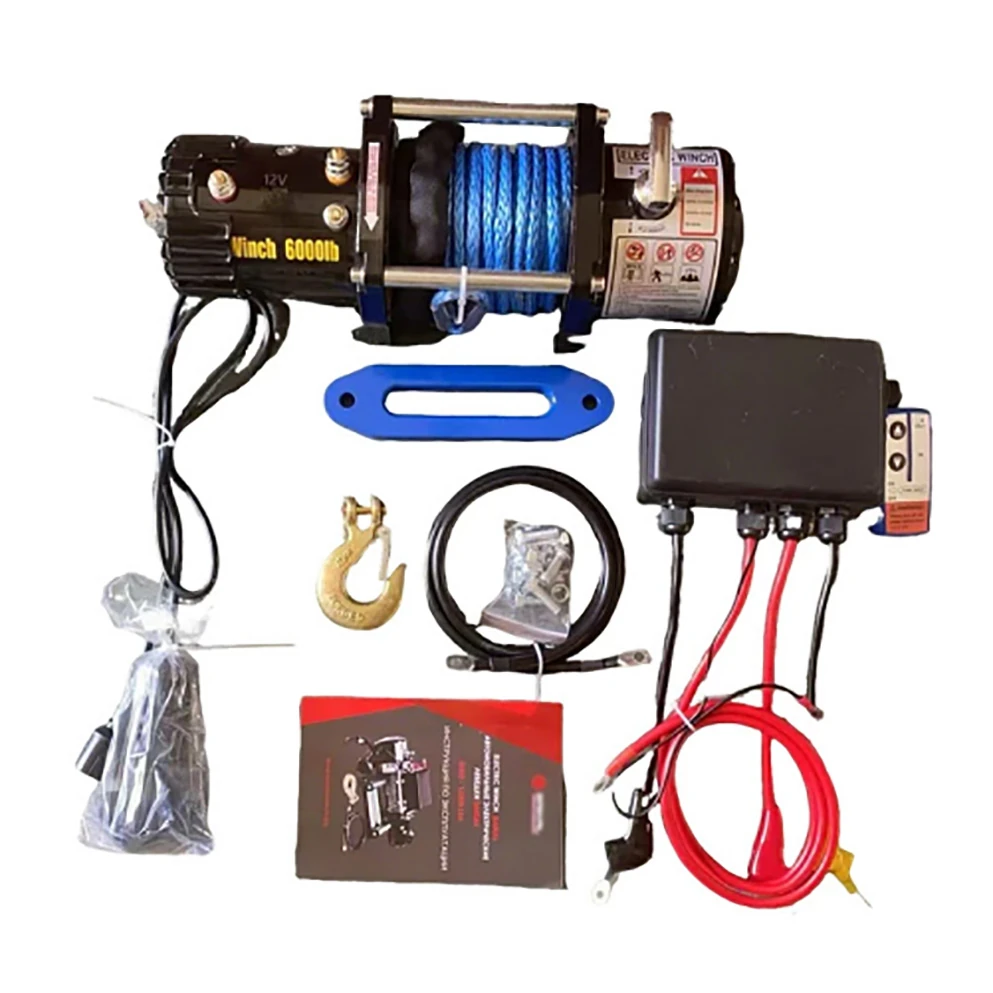
Our electric winch configuration is designed specifically for ATV, UTV, 4×4 and off-road truck recovery applications.
The model features:
- Permanent-magnet DC motor
- Three-stage planetary gear drive
- Automatic brake
- Galvanized steel cable
- Four-way roller fairlead
The specification includes a 2.0 kW / 2.7 hp motor and a 235:1 three-stage planetary gear drive. The motor provides the required driving power, while the gear reduction system increases the torque available at the drum for recovery operations.
The winch is also equipped with a 7 mm × 14 m galvanized steel cable and an automatic brake. The automatic brake is an important safety-related component during recovery because it helps hold the cable position when the motor stops operating.
Why This Configuration Fits ATV, UTV and Off-Road Recovery
The application of an electric winch determines what type of configuration is suitable. A winch designed for ATV, UTV, 4×4 and off-road truck recovery needs to provide reliable pulling performance while working with the vehicle’s electrical system. Our model is developed around these specific recovery applications, with 12V/24V DC options, a 235:1 three-stage planetary gear drive, a 7 mm × 14 m galvanized steel cable, a four-way roller fairlead and an automatic brake.
The working process is straightforward: the vehicle electrical system provides power to the DC motor, while the gearbox increases the available torque at the drum, allowing the drum to pull the steel cable during recovery operations. This configuration allows the winch to provide strong pulling performance without requiring an external hydraulic or industrial power source.
However, application suitability should always be considered carefully.
A vehicle recovery winch is designed for vehicle recovery work. Applications such as continuous industrial pulling, marine handling or regulated lifting may require different equipment specifications.
Before selecting a winch, buyers should always match the product configuration with the actual working environment.
What Should You Check Before Placing a Bulk Order?
For a single winch purchase, buyers may mainly focus on whether the product fits the vehicle and meets the basic capacity requirement. For distributors, importers and OEM buyers, however, the evaluation process needs to be more detailed because a bulk order requires not only suitable performance but also consistent specifications between units.
Before placing an order, buyers should confirm the following information with the supplier:
| Specification | What to Check | Why It Matters |
| Rated line pull | First-layer rating | Shows the advertised pulling capacity |
| Line pull by layer | Pulling force at different drum layers | Shows how usable capacity changes as cable builds up |
| Motor | Power and voltage | Confirms electrical compatibility and available power |
| Gear system | Reduction ratio and gear type | Affects torque and line speed |
| Cable | Diameter and length | Affects recovery setup and drum capacity |
| Brake | Automatic or holding configuration | Determines how the winch holds the load when the motor stops |
| Line speed | No-load and loaded speed | Helps estimate recovery time |
| Current draw | Current at different loads | Helps verify battery and wiring requirements |
| Mounting | Bolt pattern and dimensions | Confirms physical compatibility |
| Inspection | Functional and load checks | Provides evidence of production quality |
This is also why a low quotation should be reviewed carefully. A lower price does not always indicate poor quality. However, when two suppliers offer similar 6,000-lb electric winches, buyers should understand where the price difference comes from.
The difference may be related to:
- Motor specification
- Gear system design
- Cable quality
- Brake structure
- Electrical components
- Manufacturing process
The advertised pulling capacity may remain the same, while the actual product configuration differs. For this reason, buyers should request complete technical specifications before making a final purchasing decision.
How Should the Winch Be Checked Before Shipment?
For bulk orders, production consistency is an important consideration, so the finished electric winch should be checked against the agreed technical specification before shipment.
For our production, the pre-shipment inspection focuses on:
- Motor operation
- Gearbox operation
- Brake action
- Drum rotation
- Cable winding
- Control operation
- Basic load performance
This inspection process helps ensure that the delivered products match the approved technical requirements. A clear technical specification and inspection process provide a better foundation for long-term supplier cooperation.
Frequently Asked Questions
What is the difference between an electric pulling winch and a lifting winch?
A pulling winch is primarily designed to move loads horizontally or at an angle, while a lifting winch is designed to raise and lower suspended loads. Lifting applications require dedicated load-holding, braking, safety, and regulatory provisions and should not be assumed to be covered by a standard recovery winch.
How do I choose between a 12V and 24V electric winch?
Choose according to the electrical system of the vehicle or equipment and confirm motor, wiring, and power requirements with the supplier. A 24V electric winch is appropriate only when the available electrical system and complete winch configuration are compatible.
Is a 6000–lbs electric winch suitable for a 6000–lbs vehicle?
Not necessarily. Terrain, slope, resistance, recovery conditions, and pulling geometry can substantially affect the required pulling force. Winch capacity should be evaluated against the actual recovery scenario.
What should I request from an electric winch manufacturer?
At minimum, request the complete technical specification, motor and gearbox information, cable specifications, braking configuration, electrical requirements, dimensions, and available pre-shipment inspection information.
Conclusion: Compare the Configuration, Not Just the Capacity
When sourcing an electric winch, the rated pulling capacity is an important starting point, but it should not be the only specification considered. A proper evaluation should include motor power, gearbox design, cable specification, brake system, electrical requirements, and performance under different loads.
For vehicle recovery applications, buyers should select a suitable capacity reserve and understand how the pulling force changes as cable layers increase on the drum. The vehicle’s electrical system should also be capable of supporting the motor when the winch operates under load.
For ATV, UTV, 4×4 and off-road truck recovery applications, the overall configuration needs to match the vehicle, recovery conditions and intended working environment. More importantly, when comparing different suppliers, buyers should confirm that quotations are based on comparable technical specifications rather than comparing capacity numbers alone.
The key point is: Do not compare electric winches by capacity alone. Compare the complete configuration behind the capacity.If you are comparing electric winches from different suppliers, request detailed technical specification before making the final purchasing decision, including motor power, voltage, gear reduction, cable diameter and length, brake type, line speed, current draw and mounting dimensions. For our 12V/24V electric winch, we can provide complete technical specifications and quotations for bulk orders, OEM projects and distributor cooperation. When sending an RFQ, please include the required voltage, application, cable requirements and mounting dimensions so that different products can be compared on the same technical basis.