1. Introduction
Efficient material handling has become essential for reducing operating costs and improving productivity in today’s warehouse and industrial operations. As supply chains continue to expand and labor costs rise, more businesses are replacing manual handling tools with electric-powered equipment.
Among these solutions, the electric pallet stacker has become widely used in warehouses, manufacturing plants, and logistics centers.
This guide explains how electric pallet stackers work, their main types, key benefits, and how to choose the right model based on real operational requirements and technical specifications.
2. What Is an Electric Pallet Stacker
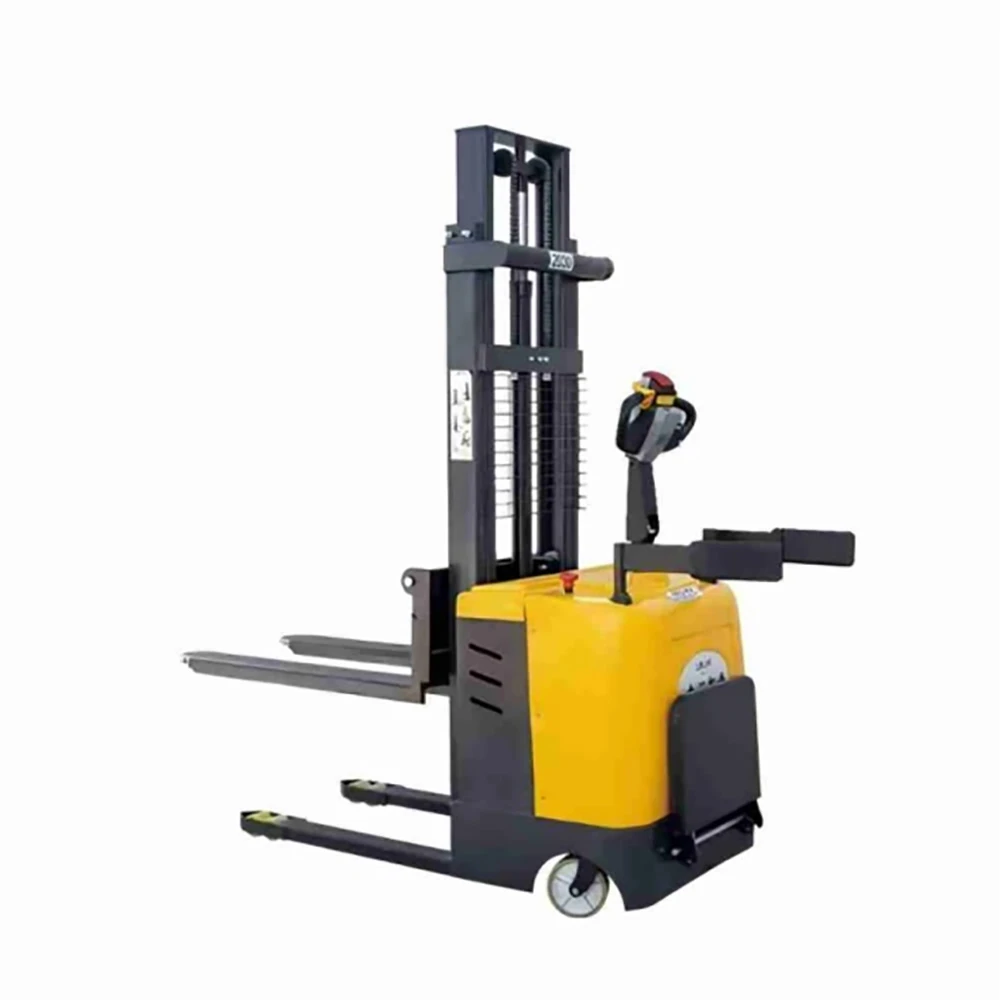
An electric pallet stacker is a battery-powered material handling machine designed to lift, move, and stack palletized goods. Unlike manual pallet jacks, it uses electric drive and lifting systems to reduce physical labor and improve handling efficiency.
The rider-type stacker covered in this guide is designed for stand-driving operation and supports adjustable fork width for different pallet sizes. It is commonly used for medium-duty warehouse operations requiring vertical stacking.
3. Main Types of Electric Pallet Stackers
Electric pallet stackers can be divided into several categories based on operation mode and application:
3.1 Semi-Electric Stacker
Uses electric lifting with manual movement. Suitable for light-duty and budget-limited applications.
3.2 Full Electric Stacker
Both driving and lifting are electrically powered. Designed for frequent use and higher efficiency operations.
3.3 Walkie Electric Stacker
Operated by walking behind the unit using a control handle. Best suited for short-distance and narrow-space applications.
3.4 Rider-Type Electric Stacker
Operators stand on the platform during operation, making it more efficient for medium to large warehouses with longer travel distances.
4. Key Advantages of Electric Pallet Stackers
4.1 Higher Warehouse Efficiency
Electric stackers significantly improve handling speed compared to manual equipment. With controlled lifting and driving functions, operators can complete stacking tasks faster and with less effort.
4.2 Lower Labor Intensity
By replacing manual lifting and pushing, electric stackers reduce operator fatigue and allow a single worker to handle more workload per shift.
4.3 Improved Operational Safety
Modern stackers are equipped with essential safety systems such as emergency stop functions, electromagnetic braking, and operator protection structures to reduce workplace risks.
4.4 Better Use of Warehouse Space
Compact design and tight turning radius allow efficient operation in narrow aisles, helping maximize storage density in warehouses.
4.5 Reduced Long-Term Operating Cost
Compared with fuel-powered or manual equipment, electric stackers have fewer mechanical components, resulting in lower maintenance requirements and energy consumption.
5. Electric Pallet Stacker vs Manual Pallet Jack
| Feature | Electric Pallet Stacker | Manual Pallet Jack |
| Power source | Electric motor | Human effort |
| Function | Transport + stacking | Horizontal transport only |
| Lifting height | Up to several meters | Very limited |
| Operator effort | Low | High |
| Productivity | High | Low |
| Application | Warehouses with racking systems | Simple ground movement |
Understanding the difference between electric stackers and manual pallet jacks is essential for selecting the right equipment.
When to Use an Electric Pallet Stacker
- When goods need to be stacked on warehouse racks
- When daily handling volume is high
- When operator fatigue needs to be reduced
- When warehouse space utilization is important
When a Manual Pallet Jack Is Enough
- Low-frequency pallet movement
- Flat ground transport only
- Very limited budget
- Short-distance handling tasks
6. Common Applications Across Industries
Electric pallet stackers are widely used across multiple industries:
- Warehousing & Logistics: pallet storage, retrieval, and racking operations
- Manufacturing Plants: raw material supply and finished goods handling
- Retail & Supermarkets: stockroom and back-end logistics
- Food & Beverage Industry: clean and stable indoor material handling
- Cold Storage Facilities: temperature-controlled warehouse operations
Their versatility makes them suitable for most indoor industrial environments.
7. How to Choose the Right Electric Pallet Stacker
Selecting the correct model depends on actual working conditions rather than specifications alone.
7.1 Load Capacity
Most industrial models support up to 2000kg, which is suitable for standard pallet loads.
7.2 Lifting Height
Choose based on racking system height. Common ranges include:
1.6m, 2.0m, 2.5m, up to 5.0m.
7.3 Warehouse Layout
Key factors include:
- Aisle width (typically 90–126 cm depending on model)
- Turning radius requirements
- Floor condition and working space
7.4 Battery System
Most models use 24V industrial batteries designed for extended operation. For multi-shift use, spare batteries or fast charging solutions may be required.
8. Common Buying Mistakes to Avoid
Many buyers make similar mistakes when selecting pallet stackers:
- Choosing the wrong lifting height for their racking system
- Ignoring pallet type compatibility
- Underestimating aisle width limitations
- Selecting insufficient battery capacity for daily workload
- Focusing only on price instead of long-term operating efficiency
Avoiding these mistakes can significantly improve return on investment.
9. Maintenance Considerations
To ensure long service life, regular maintenance is recommended:
- Keep battery properly charged and avoid deep discharge
- Inspect wheels and forks for wear
- Check braking system regularly
- Ensure hydraulic and lifting components remain clean and functional
Proper maintenance reduces downtime and improves equipment lifespan.
10. Why Manual Handling Equipment Is Being Replaced
More warehouses are transitioning from manual to electric equipment due to:
- Increasing labor costs
- Higher demand for operational efficiency
- Stricter workplace safety requirements
- Growth of e-commerce and fast logistics cycles
Electric pallet stackers provide a scalable solution for modern warehouse operations.
11. Choosing a Reliable Supplier
When investing in industrial equipment, supplier reliability is as important as machine performance.
A professional manufacturer should provide:
- Stable product quality control
- International certifications
- Customization options for different warehouse needs
- Technical support and after-sales service
- Export experience for global markets
Working with an experienced supplier ensures long-term operational stability and reduced procurement risk.
12. Featured Product and Manufacturer
Here is a practical example that meets the above selection criteria. Our rider-type electric pallet stacker (2000kg capacity) offers stand-driving operation, adjustable fork width, and lifting height options from 1.6m to 5.0m. Key specifications include a 1.5 kW drive motor, 2.2 kW lifting motor, 24V/206Ah Tianneng maintenance-free battery, lift speed of 80 mm/s (full load), and turning radius of 180 cm. Important: this model is compatible with single-faced and open-bottom pallets, but NOT with double-faced or block pallets. Safety features include emergency stop switch, electromagnetic service brake, and protection arm.
This stacker is supplied by Baoding OTOY Trading Co., Ltd, established in 2008 in Hebei province, serving over 80 countries worldwide. The company is ISO9001 certified, offers factory-direct pricing, and provides customization options for fork width, lifting height, and other specifications.
13. Conclusion
Electric pallet stackers have become an essential tool in modern warehouse and factory operations. With strong lifting capacity, flexible height options, and improved safety features, they significantly outperform manual handling tools in efficiency and productivity.
By selecting the right model based on warehouse layout, pallet type, and operational needs, businesses can achieve faster workflow, lower labor costs, and safer material handling.
For companies looking to upgrade their material handling systems, electric pallet stackers offer a practical and long-term investment in operational efficiency.