A common misconception is the erroneous belief that “a single model can serve every application scenario.” However, not all warehouses require an electric pallet stacker; conversely, not all manual stackers are suitable for handling heavy loads.
This guide aims to help you select the right stacker truck based on your needs. We specifically selected two products for a side-by-side comparison: one is a manual stacker with a load capacity of 2000 kg and adjustable forks; the other is an electric mini stacker with a load capacity of 1 ton. This article will provide a detailed analysis of these two products, not only comprehensively examining their various technical parameters, but also weighing and analyzing their respective advantages and disadvantages in conjunction with actual application scenarios.
What a Manual Stacker Feels Like on a Normal Workday
In small warehouses receiving 10 to 15 pallets of goods daily—most of which weigh less than 1,500 kg—goods need only be placed on ground-level racks or low-level racks not exceeding 1.5 meters in height.
A manual pallet stacker requires no charging station, extension cord, or battery check. Simply roll it to the pallet, pump the handle to lift and turn the release knob to lower, and the hydraulic system lifts the load. When finished, roll it into a corner for storage.
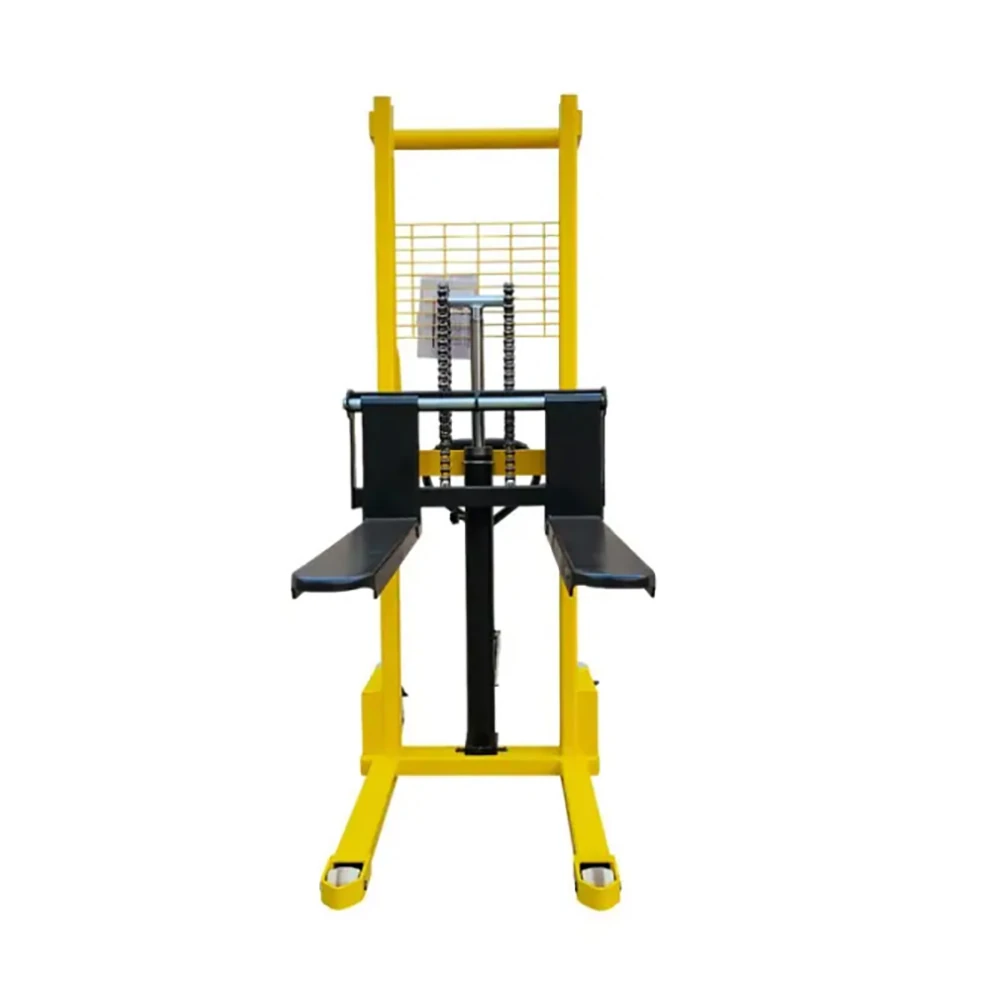
Based on real specifications of the 2000KG manual lift pallet stacker:
·Adjustable forks ranging from 11.6 to 36.6 inches—you are no longer limited to a single pallet size.
· Fork height lowered to 3.5 inches—easily slides under most standard pallets.
· 63-inch (1600 mm) lift height—sufficient to meet access requirements for mid-level shelving, extending beyond mere ground-level stacking.
· Fully Welded Steel Chassis—Effortlessly handles daily bumps, offering rugged durability that won’t fall apart.
The machine weighs 440lbs. That is heavy enough to be stable, but light enough for one person to maneuver on flat ground.
The Downside
You pump. Every lift.
If you stack 50 pallets a day, your arm will feel it.
Manual stackers are not made for high-frequency work — they are made for low-frequency, high-capacity jobs.
What an Electric Mini Forklift Changes in Your Workflow
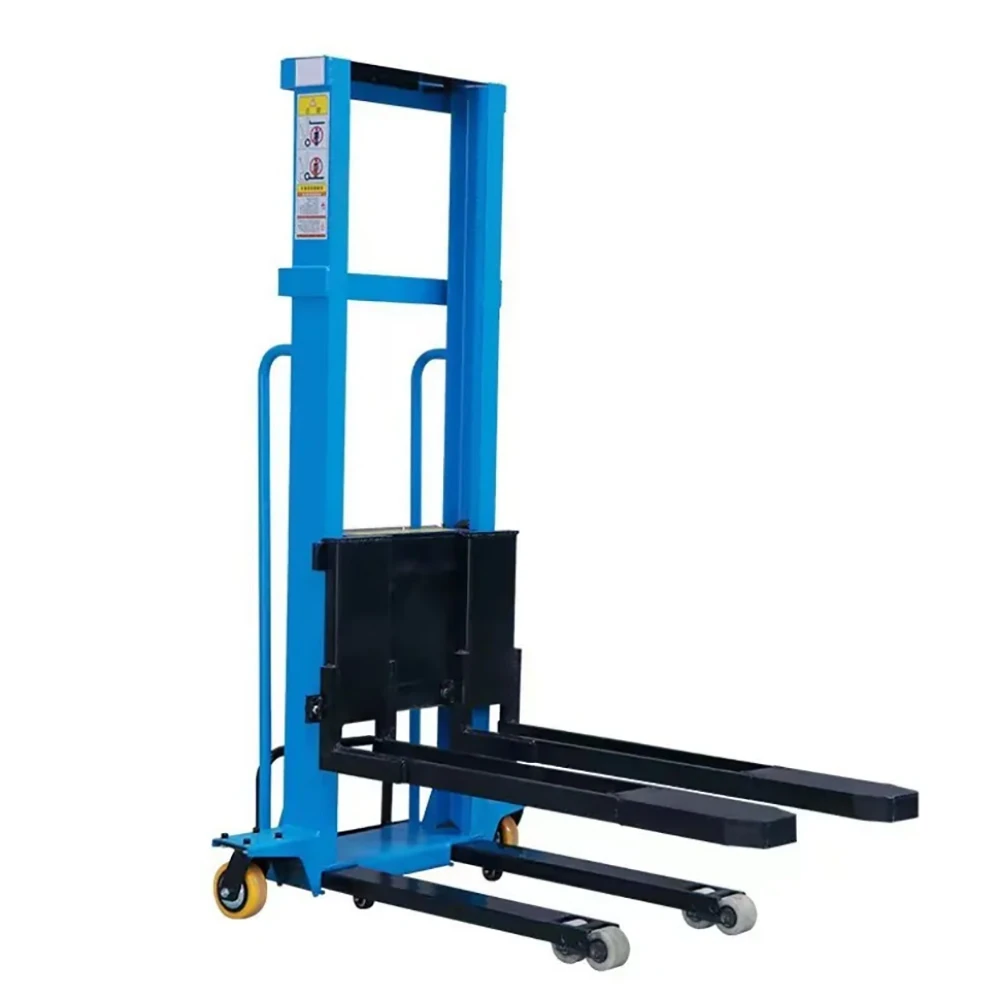
Now, let’s imagine another scenario: a busy parcel sorting center, or a large shopping mall that receives a constant stream of goods around the clock. The pallets here are lightweight, but the flow of goods never stops. That 1-ton electric stacker is suitable for this kind of environment.
From the product data:
1 ton (1000KG) capacity — Although its load-bearing capacity is not as high as that of a manual forklift stacker, it is more than sufficient for daily retail and logistics handling work.
1.3m or 1.6m lift height — It’s below the upper limit for manual models, but practical for most indoor shelving units.
Runs on electricity — no manual pumping, so your feet and arms won’t get tired.
Zero emissions and low noise — It is crucial for the food, pharmaceutical, and indoor shopping mall environments.
Emergency braking + speed limiter — reduces accident risks in tight spaces
This electric unit is specifically designed for use in narrow warehouse aisles. If your workspace is particularly confined—such as at port terminals, retail store storerooms, or courier sorting centers—this feature offers a significant advantage.
While manual stackers are also capable of operating in tight spaces, the electric version substantially reduces operator physical strain when frequent, repetitive lifting cycles are required.
The Downside
It entails high upfront costs and, over time, requires ongoing battery maintenance. Furthermore, its lifting capacity is limited to just one ton; therefore, if the loads you handle on a daily basis frequently exceed 1,000 kilograms, this model is clearly not suitable for your needs.
Side-by-Side: Manual vs Electric Based on Real Numbers
Here is the actual comparison using the two product lines.
| Factor | 2000KG Manual Stacker | 1-Ton Electric Stacker |
| Max load | 2000KG (4400 lbs) | 1000KG (1 ton) |
| Lift height | Up to 63″ (1600mm), other variants up to 3.0M | 1.3M or 1.6M |
| Fork width | Adjustable 11.6–36.6″ | Fixed |
| Power source | Hand pump + foot pedal | Rechargeable battery |
| Maintenance | Minimal (hydraulic oil) | Battery + motor + electrical |
| Best for | Occasional heavy lifts | Frequent light lifts |
| Noise/emissions | Zero | Zero emissions, low noise |
Three Questions That Decide Which One You Need
1. How Much Does Your Heaviest Pallet Actually Weigh?
· Over 1000KG → manual only.
· Under 800KG → you have a choice.
2. How Many Lifts Per Hour?
· Less than 5 lifts/hour → manual is fine. Save your money.
· More than 15 lifts/hour → buy the electric. Your operators will thank you.
3. Where Will You Use It?
• This type of electric equipment performs well in warehouse environments with power access and narrow aisles.
•In the back of the warehouse where there is no convenient power outlet—or outdoors—a manual forklift is preferable.
Why Businesses Still Buy Adjustable Fork Manual Stackers (Even in 2026)
People might assume that an electric model is inherently superior simply because it is more modern.
This assumption is incorrect. Manual stackers with adjustable forks remain widely used—for three reasons.
Ready to Work Anytime
First, you do not need to wait for the battery to charge.
When work needs to begin immediately, a manual stacker is always ready to go.
Practical Safety Features
Secondly, the metal mesh guard and safety wheel guard provide genuine protection—shielding operators from injury by the lifting chain and preventing rolling accidents.
Better Load Control
Third, the braking system enables a controlled descent.
This is particularly important when placing fragile items onto shelves.
Long Service Life
One more point: even if the battery performance degrades, the manual stacker will not be rendered obsolete as a result.
Ten years from now, the manual stacker will still function just as normally as it does today.
When the 1-Ton Electric Mini Forklift Is the Clear Winner
Express Logistics Hubs
Workers handle hundreds of lightweight pallets per shift, making the reduction of fatigue a significant advantage.
Port Terminals
Confined spaces often make the use of large forklifts difficult. In such environments, electric mini-forklifts—despite their higher initial cost—can quickly recoup their investment by reducing operator fatigue and enhancing operational efficiency.
Conclusion: No Single Right Answer, But One Right Answer for You
If your loads are over 1000KG, or you only stack pallets occasionally, or you do not want another battery to manage — buy the 2000KG manual lift pallet stacker with adjustable forks.
If your loads are under 1000KG, you work in a narrow-aisle environment, and you lift pallets constantly throughout the day — buy the 1-ton electric stacker.
If you are interested in our products, please feel free to contact us for more information or a quotation.
Frequently Asked Questions
Q1: Can a Manual Stacker Really Handle 2000KG Safely?
Yes.
The model shown has an all-welded steel chassis, mast rollers, mesh guard, and brake system. It is designed for 4400lbs.
Q2: Is a Manual Stacker Slower Than Electric?
For a single lift, no.
For the 20th lift of the day, yes.
Q3: Do I Need Special Training for the Electric Mini Forklift?
Basic training on emergency braking and speed limiter is recommended.
But it is not as complex as a full-size forklift.
Q4: Which One Lasts Longer?
The manual stacker has fewer parts to break.
With basic care, it will outlast the electric model.
Q5: Can I Use the Manual Stacker for Shelf Stocking?
Yes.
Up to 63″ lift height, and other variants go to 2.5M or 3.0M.
The adjustable forks help with different pallet sizes.