Precision Engineering for Industrial Lifting
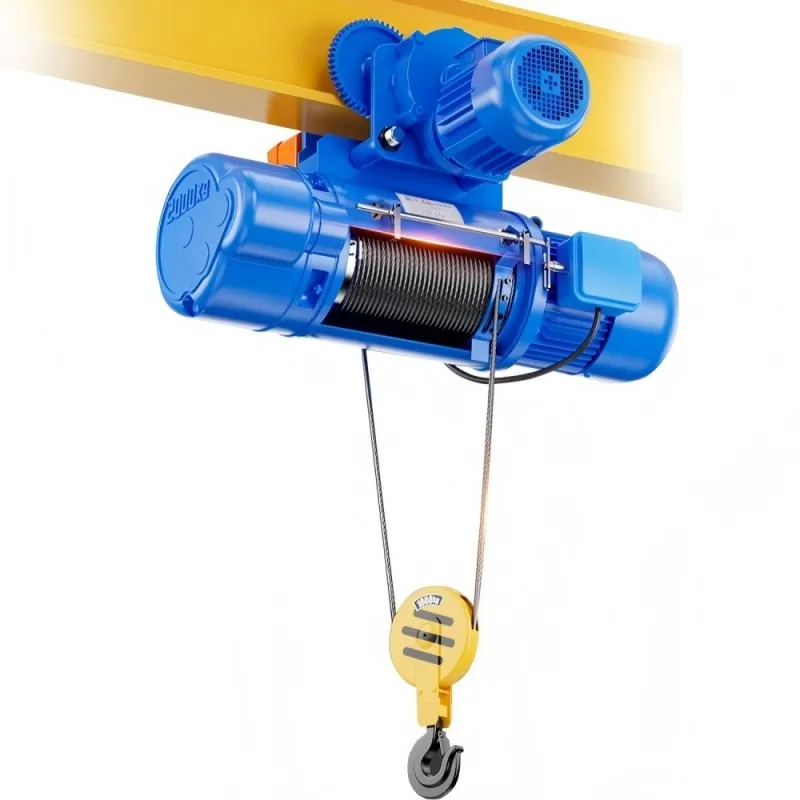
When it comes to large-scale material handling, the CD1 and MD1 series wire rope hoists are the industry standard for reliability. Unlike light-duty hoists, these units are designed to be mounted on single-beam cranes, bridge cranes, or gantry cranes, providing seamless vertical movement and horizontal travel along I-beams.
Versatile Industrial Applications
Whether you are upgrading a factory production line or managing a logistics terminal, our electric wire rope hoists provide the structural integrity required for safety and efficiency. With a focus on long service life and minimal maintenance, Otoy Tools is your trusted partner for high-capacity industrial lifting equipment.
Superior Construction and Safety Features
Otoy Tools ensures that every industrial wire rope hoist is built to withstand harsh environments. Our hoists feature high-quality steel wire ropes with superior tensile strength and large-diameter drums to reduce wear. The motors are designed for high heat dissipation, allowing for longer duty cycles during continuous operation. Additionally, integrated safety limit switches and robust braking systems ensure that your loads are always under total control.
Common questions from our news readers and partners
The primary difference lies in the lifting speed. The CD1 is a single-speed hoist, ideal for standard lifting tasks. The MD1 is a dual-speed hoist, which includes a slow-speed gear for precise positioning. If your work involves delicate assembly or precise machine loading, the MD1 is the recommended choice.
Yes, the CD1 and MD1 hoists are designed to be used as part of a trolley system that runs along the bottom flange of I-beams or H-beams. They are compatible with single-beam cranes, overhead cranes, and gantry cranes commonly found in industrial workshops.
The MD1 electric hoist utilizes a dual-motor or specialized gear arrangement. By activating the auxiliary slow-speed motor/gear, the hoist can move the load at a fraction of the normal speed (often 1/10th), allowing the operator to position heavy components with extreme accuracy.