Key Takeaways
- Calculate the total suspended load, including the workpiece and lifting accessories, before selecting the rated capacity.
- Measure the required hook travel and available headroom separately.
- Match the hoist’s duty classification to lifting frequency, operating hours, and load distribution.
- Choose a fixed hoist for one lifting point or a trolley-mounted hoist when loads need to move along a compatible beam.
- Confirm lifting speed, power supply, installation dimensions, and applicable safety requirements before ordering.
Introduction
An electric hoist can have sufficient lifting capacity and still be unsuitable for a particular job. The hook may not reach the required height, the trolley may not fit the existing beam, or the selected configuration may not suit the planned operating cycle.
These problems often begin with incomplete specifications. A request for a 5-ton hoist, for example, does not tell the supplier how high the load must travel, how often the hoist will operate, or whether horizontal movement is required.
An electric wire rope hoist uses a motor-driven wire rope mechanism to raise and lower loads. For industrial applications, buyers should evaluate capacity, lifting height, operating frequency, and installation conditions together rather than choosing equipment by rated capacity alone.
How Do You Choose the Right Hoist Capacity and Duty Class?
Start by calculating the complete suspended load and identifying how frequently the hoist will operate. These factors help determine the required capacity and suitable duty classification.
How Much Rated Capacity Do You Need?
The total suspended load includes the workpiece and lifting attachments, such as lifting beams, clamps, and slings where applicable.
For example, a machine component weighs 4,200 kg and its lifting fixture weighs 300 kg. The total suspended load is 4,500 kg. A 5-ton hoist may cover this load by rated capacity, but the buyer must also check the lifting arrangement, operating duty, and supporting structure.
When comparing an electric hoist 5 ton, compare the complete suspended load with the rated capacity. If the total exceeds 5 tons, this capacity is unsuitable. Even when the load is within the rating, the required lifting height, duty classification, and installation conditions still need to be checked. Never select a hoist based on workpiece weight alone or operate it above its rated capacity.
What Duty Class Is Suitable for Your Workload?
Hoist duty class should match lifting frequency, operating hours, and load distribution. A maintenance hoist used a few times a day has different requirements from a production-line hoist that repeats lifting cycles across multiple shifts.
Record the typical number of lifts per hour, operating hours per shift, and number of shifts. Then ask the supplier to confirm the suitable duty classification for the selected model.
ISO 4301-1:2016 provides a framework for classifying cranes and their mechanisms according to service conditions, including working cycles and load spectrum. It can help buyers understand why workload patterns matter.
How Do You Determine Lifting Height, Speed, and Trolley Type?
Once the load and workload are clear, define how the hoist needs to move. Hook travel, available headroom, lifting speed, and horizontal travel all affect the required configuration.
How Much Lifting Height and Headroom Do You Need?
Hook travel is the vertical distance between the lowest position needed to attach the load and the highest position needed to complete the lift. Headroom is the space available for the hoist and hook to operate beneath the supporting structure.
Consider a workshop that lifts a motor from floor level onto a machine platform. The hook must descend far enough to connect the motor and rise high enough for the motor and lifting attachment to clear the platform. If vertical clearance is limited, a hoist with sufficient lifting capacity may still be unsuitable because its dimensions restrict hook movement.
Measure the lowest and highest required hook positions, then check the available space between the supporting structure and nearby equipment. If clearance is limited, provide the measurements to the supplier and request an installation drawing before ordering.
Should You Choose Single-Speed or Dual-Speed Lifting?
Lifting speed affects handling time and positioning accuracy. Fast lifting may suit straightforward material transfer, while careful positioning can be more difficult when a heavy component must align with mounting points.
For general material handling where precise placement is not critical, a single-speed configuration may be sufficient. For machinery installation, mold changes, or assembly work, a dual-speed arrangement may be worth considering if available. If the process requires adjustable speed, ask the supplier whether a suitable variable-frequency control option is offered.
For example, when lowering a gearbox onto its mounting points, an operator may need to raise the load quickly and then approach the final position slowly. A suitable low-speed function can help control the final placement.
For repetitive production, check whether the available lifting speed meets the required cycle time and is compatible with the selected capacity and duty classification.
Do You Need a Fixed Hoist or a Trolley-Mounted Hoist?
A fixed hoist lifts loads at one position, while a trolley-mounted hoist also moves them horizontally along a compatible beam. Choose a fixed model for a single lifting point and consider a trolley-mounted model when materials need to travel between workstations.
Before selecting a trolley, check the beam profile, flange dimensions, travel distance, and supporting structure. A standard trolley does not provide movement across separate runways unless the larger lifting system is designed for that purpose.
For installations covered by OSHA 29 CFR 1910.179, applicable overhead and gantry crane requirements should be checked before commissioning.
Why Consider OTOY’s CD Electric Wire Rope Hoist with Trolley?
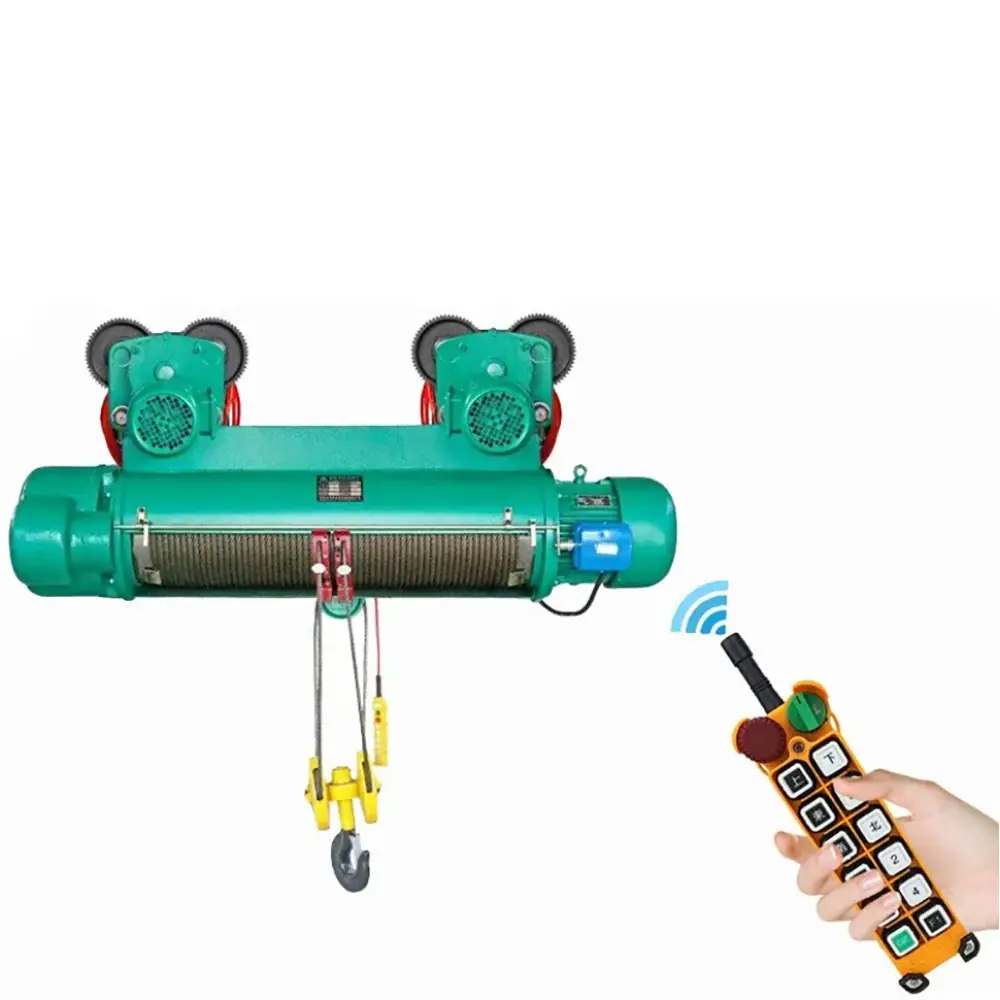
OTOY lists a CD electric wire rope hoist with trolley for industrial applications. The published product information lists a 380V configuration and 50Hz/60Hz frequency information. Buyers should confirm the complete technical specifications and available configuration with the supplier.
Product Information at a Glance
| Item | Published information |
| Product | CD electric wire rope hoist with trolley |
| Power supply | 380V; 50Hz/60Hz listed |
| Lifting and movement | Wire rope lifting with trolley travel |
| Rated capacity and lifting height | Confirm with supplier |
Before selecting a model, confirm its rated capacity, lifting height, speed, duty classification, overall dimensions, and trolley compatibility. These details are needed to determine whether the available configuration suits the load and installation.
How Does Wire Rope Lifting Support Industrial Handling?
The wire rope mechanism raises and lowers suspended loads during lifting operations. Buyers should consider the required lifting height, total suspended load, and operating frequency together. The selected model must suit both the load and the planned working cycle.
This makes the complete lifting requirement more useful than rated capacity alone when comparing hoist options.
How Does the Trolley Help Move Loads Between Workstations?
The trolley allows the hoist to travel horizontally along a compatible beam while the wire rope mechanism handles vertical lifting. This arrangement may suit workshops and production areas where materials need to move between nearby workstations along an overhead path.
For example, a component may need to move from a loading point to an adjacent assembly station. A trolley-mounted arrangement can support this movement along the designed beam path, provided the beam, supporting structure, and travel distance are suitable.
What Should You Know About the Listed Power Supply?
OTOY’s product page lists a 380V configuration and 50Hz/60Hz frequency information. These details provide a starting point for checking electrical compatibility, but they do not confirm that every voltage and frequency combination is available for every model.
Before ordering, confirm the required voltage, frequency, phase, and motor configuration with OTOY. Matching the equipment to the site’s electrical supply helps avoid choosing a configuration that cannot be connected as planned.
Frequently Asked Questions
What Power Supply Does OTOY’s CD Electric Wire Rope Hoist List?
OTOY’s product page lists a 380V configuration and 50Hz/60Hz frequency information. Confirm the required voltage, frequency, phase, and motor configuration with OTOY before ordering.
Does OTOY’s CD Electric Wire Rope Hoist Come with a Trolley?
The listed product is a CD electric wire rope hoist with a trolley. The wire rope mechanism handles vertical lifting, while the trolley provides horizontal travel along a compatible beam. Confirm beam compatibility and required travel distance before selecting the configuration.
How Can Buyers Confirm the Capacity and Lifting Height of OTOY’s CD Hoist?
The available product information does not provide complete capacity and lifting-height details. Contact OTOY with the intended load and required hook travel, and request confirmation of the available capacity, lifting height, speed, and duty classification.
How Do You Choose the Right Electric Hoist Capacity?
Calculate the total suspended load, including the workpiece and lifting attachments. Compare the result with the hoist’s rated capacity, then check the duty classification and supporting structure. Never exceed the rated load.
How Do You Check Whether a Trolley Fits an I-Beam?
Measure the beam’s flange width and confirm its profile. Compare these measurements with the trolley’s adjustment range and dimensions. Also verify the supporting structure’s load capacity and obtain confirmation of compatibility before ordering.
Conclusion
An industrial hoist should do more than lift the required weight. It should fit the installation, support the planned operating cycle, and suit the way materials move through the workplace. When loads need to travel between nearby workstations, a trolley-mounted design can combine vertical lifting with horizontal movement along a compatible beam.
OTOY’s CD electric wire rope hoist with trolley is an option for buyers evaluating this type of lifting arrangement. Its published product information lists a 380V configuration and 50Hz/60Hz frequency information. Before ordering, confirm the available lifting capacity, hook travel, speed, duty classification, trolley compatibility, and electrical requirements with OTOY.
If you are looking for a reliable electric wire rope hoist supplier, feel free to contact OTOY for product options, technical specifications, and quotations based on your lifting capacity, lifting height, trolley requirements, and industrial application needs.